Qua Fen Common

Ecology Articles

This page contains a number of articles relating to the ecology of Qua Fen Common
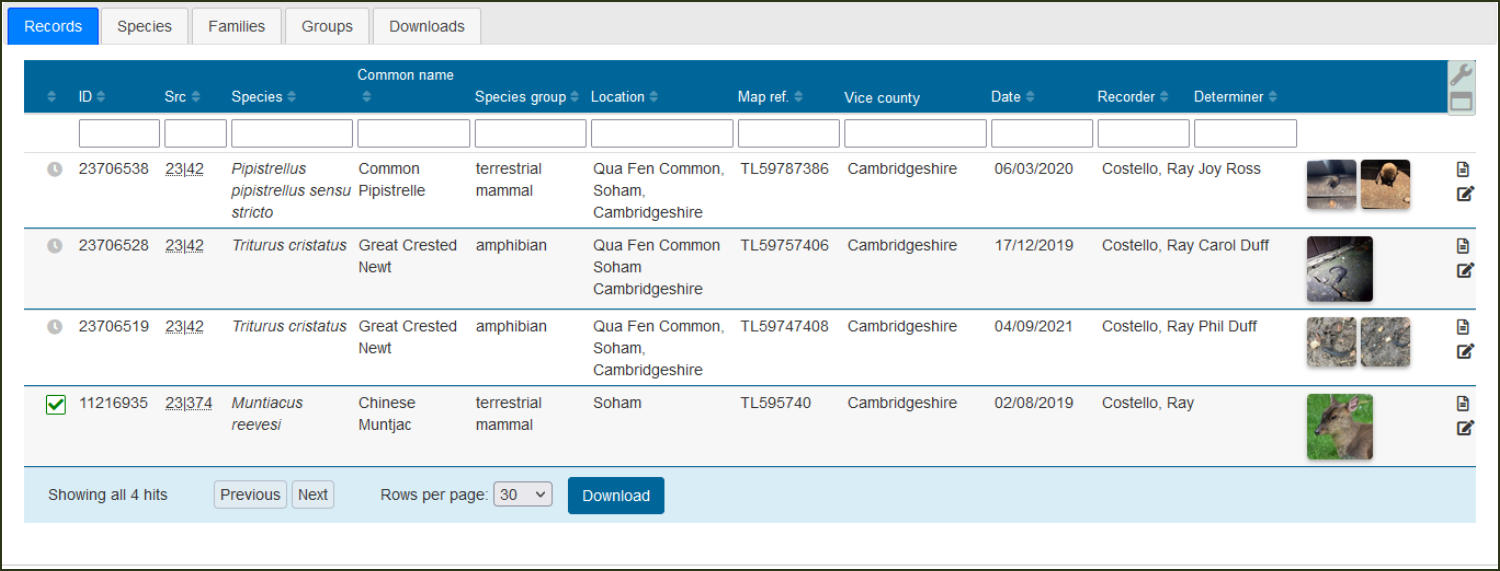
 iRecord, is a database open to the general public and allows users to record sightings of wildlife and also plants. Additionally users can search the database, currently holding some 18million records by species or location. iRecord is operated by the Biological Records Centre (BRC) as part of the work of the UK Centre for Ecology & Hydrology (UKCEH). BRC is supported by the Joint Nature Conservation Committee (JNCC) and UKCEH (through National Capability funding via Natural Environment Research Council (NERC)).  iRecord is a website for sharing wildlife observations (biological records), including associated photos – you can register quickly and for free. Once registered, you can add your own records for others to see, and you can see what has been recorded by others. Your data will be kept secure and will be regularly backed up.  Automatic checks will be applied to your observations to help spot potential errors, and experts can review your sightings. All wildlife sightings are shared with other users and made available to National Recording Schemes (and their county recorders where relevant), and to Local Environmental Records Centres. Most records are also shared more widely via the NBN Atlas, and with a range of bona fide organisations for research and conservation.  The goals and aims of iRecord are as follows:  •	    Record all the wildlife you see •	    Securely store and keep track of your records •	    Benefit from automatic data checks and review by experts •	    Share your sightings with the recording community •	    Explore dynamic maps, reports and graphs of your data •	    Explore data shared by other recorders in your area and/or for species groups you are interested in •	    Contribute to science and conservation  The system can be accessed using an ‘APP’ on mobile devices or a PC/Any Device with a browser and is simple and easy to operate.  As part of our combined efforts to support and maintain the well being of the common, by adding records of our sightings we create a stronger visibility and strengthen our case for the future of the common. Creating an account is easy, taking only a few minutes to register. Records you enter are verified within a few days by experts. Below is an example listing from the Web Masters records. Sightings can be viewed using the map provided (screenshot below of Qua Fen Common) and are shown as small circles and squares. Selecting the indicators will provide details of the sighting.     References: You can access iRecord with the following URL:   The Biological Records Centre (BRC) can be found at:   The UK Centre for Ecology & Hydrology can be found at:   Thanks to Rosemary Aitchison for details of iRecord

iRecord - Wildlife and Plant records database
 Thanks to Hamish and Joy Ross for spotting an article published on the 10th February by the Ely Standard. This is really good news and if fully implemented the new scheme will ensure that all planning applications go through a consultation process provided by ECDC.  The scheme will aim to increase biodiversity, via new development, and help with Natural Cambridgeshire's vision of doubling the area of rich wildlife habitats and natural greenspace across Cambridgeshire and Peterborough.  Members at the East Cambridgeshire District Council (ECDC) finance and assets committee approved a supplementary planning document (SPD) for Natural Environment on February 6.  A full version of the draft SPD is available as a PDF and can be found here:   The scheme comes after ECDC joined more than 200 councils across the UK in declaring a climate emergency and pledged to take action to reach net zero carbon by 2050.  Councillor David Brown, chairman of ECDC's finance and assets committee, said: "The SPD plays a vital role in helping to highlight sites across the district which are of local, national or international importance, including Wicken Fen which is home to more than 8,500 species of rare plants, birds and animals.  "This SPD outlines the council's proposed approach; we do not want to just protect the wildlife that the district is home to, but also create new areas for biodiversity to thrive.  "Applicants seeking planning permission should also look to create new habitats such as woodlands and ponds as well as homes that incorporate wildlife friendly measures, such as bird and bat boxes."   The consultation will start in mid-February and last until towards the end of March.  Councillor Anna Bailey, leader of ECDC, said: "The SPD makes clear that the council will not accept development that either harms wildlife sites or fails to make enough efforts to improve or increase areas for wildlife.  "Applications for development must include genuine net gain for biodiversity - we want an approach to development that leaves the natural environment in a measurably better state than it was beforehand."  The finance and assets committee also approved to consult on a custom and self-build SPD.  The council is also working on a further SPD to support the forthcoming environment and climate change strategy and action plan. A draft is expected in the summer.   To read more and take part in the consultations go  References - thanks to “ The Ely Standard”

Natural Cambridge - ECDC to Provide Consultation help on

Doubling Nature Vision - Update 23rd February 2020

 Natural Cambridgeshire, the local nature partnership, announced on Monday 29th July 2019, ambitious plans to doubling Nature with the area of rich wildlife habitats and natural green space across Cambridgeshire and Peterborough with the aim of creating a world-class environment where nature and people thrive, and businesses prosper. The ambition has been drawn up by the partnership, including local authorities, statutory agencies, conservation charities, housing developers and community groups.  Cambridgeshire currently has one of the smallest areas of any county in the country, relative to size, of land managed for nature. Natural Cambridgeshire wants to double that figure, from around 8% to 16%. (which is the national average)   The ambition has been drawn up by the partnership, including local authorities, statutory agencies, conservation charities, housing developers and community groups. It was launched today by Tony Juniper, Chair of Natural England and James Palmer, Mayor of the Cambridgeshire and Peterborough Combined Authority, at separate events at Waterbeach Barracks and O&H Hampton, both outstanding examples of how high-quality housing development can deliver new areas of nature rich landscape.  Greater Cambridgeshire is one of the fastest growing areas within England, with plans for significant additional development and major infrastructure to provide tens of thousands of new homes and significant new employment opportunities over the coming decades. The National Planning Policy Framework (NPPF) promotes sustainable development, which requires moving from net losses in biodiversity to net gains and for development to enhance the natural environment, including natural capital or ecosystem services.  New developments which adhere to sound sustainability principles ensure the protection and enhancement of this natural capital by creating high quality multifunctional habitats that support common, threatened and, or declining species. The provision of on-site and wider landscape-scale high quality natural environments also enhances the new development and attracts additional investments. Conversely, new developments neglecting this approach, diminishes both the quantity and quality of the natural environment, its biodiversity and the essential benefits and services these provide.  A Toolkit has been developed to help developers and infrastructure providers to demonstrate their commitment to achieving a net biodiversity gain to the public, local authorities or shareholders. The Toolkit comprises a simple list of 10 Things to do for Nature. The Toolkit is primarily intended for major developments requiring an Environmental Impact Assessment (new settlements, major urban extensions, housing developments above 100 dwellings, commercial developments greater than 1 Ha or 1,000m² floor space, mixed use developments greater than 2 Ha, or major transport infrastructure projects). It should be used at the very outset of planning new developments, and ideally at the time of selecting sites to acquire for development.  References:

Natural Cambridge - Doubling Nature Vision